Showing posts with label TPP. Show all posts

Wednesday, September 21, 2016

TPP - the TFW Program on steroids


The Human Resources Committee, HUMA - 6 Libs, 3 Cons, and 1 NDP - released its report on the Temporary Foreign Worker Program yesterday, after a month of hearing from 43 witnesses as varied as Lululemon and the Migrant Mothers Project.

Industry complaints initiated the study. The committee was asked to find a balance between employers desperate for TFWs for jobs they are unable to fill with Canadians and the rights of workers.  

I looked up a few of those desperate employers on various Canadian job search sites. If they're not desperate enough to be advertising these job vacancies where Canadians can find them, why exactly is government in the business of engineering TFWs to fill them? 

Here's just part of the dissenting report submitted by the lone NDP committee member alongside the main report : 

International Mobility Program and the Trans-Pacific Partnership
The previous Conservative government split the Temporary Foreign Worker Program in two – the Temporary Foreign Worker Program (TFWP), which covers streams requiring a Labour Market Impact Assessment, and the International Mobility Program (IMP), in which no assessment of the impact on the Canadian labour market is required. 
The IMP is actually much larger than the TFWP (nearly twice the size in 2014), yet the committee review paid no attention to the IMP, the role that the IMP plays in the Canadian economy, and the impact that it has on workers. This is very disappointing. 
This is of particular concern since the Liberal government is looking to ratify the Trans-Pacific Partnership agreement. In addition to harming our economy, this agreement will expand access to the IMP, allowing employers to bring in foreign workers without any assessment of the impact on the Canadian labour market, even if Canadian workers are available to do the job. This has led some to describe the TPP as “the temporary foreign worker program on steroids.”
Back in 2013, 38% of foreign nationals came in under the TFWP, but 62% came in under the IMP

Then there's the ICTs, or Intra-Company Transfers, which Jason Kenney helpfully told us when he was Employment Minister were "often hard-wired into trade deals". 

ICTs "enables international companies with a presence in Canada to transfer their existing employees to their Canadian location".  And if you don't already have a branch in Canada - well, we got an app for that:
"Foreign businesses wishing to establish a Canadian enterprise may use the ICT Start-Up Visa program to bring key workers to the country to open a new office and begin doing business."
Back in June, Labour Minister MaryAnn Mihychuk told a room full of union officials that she plans to toast the day the Liberal government shuts down the Temporary Foreign Workers Program, but in the meantime they've "already quietly made one change, removing restrictions on the number of workers seasonal employers can bring in through the program this year."

Of course all this will be moot if the TPP goes through. 12A :
Canada shall grant temporary entry and provide a work permit or work authorization to Professionals and Technicians and will not:(a) require labour certification tests or other procedures of similar intent as a condition for temporary entry; or(b) impose or maintain any numerical restriction relating to temporary entry.

Friday, April 29, 2016

The Travelling TPP Roadshow


Brian Innes, president of the Canadian Agri-Food Trade Alliance (CAFTA) and tireless retweeter of all things canola, suggests canola growers have a TPP friend in Trade Minister Chrystia Freeland because her dad is a canola grower. 
In a 2012 column in The Atlantic, she mentioned her dad's canola and wheat farm is "seven times the size of Central Park".

In his column in the Hill Times a couple of days ago :
Innes notes the HoC Standing Committee on International Trade kicked off its cross-Canada pre-study public consultations with Canadians in Vancouver on April 18. 

Yes, it's a "full and open pre-study on the merits of TPP" after Canada signed TPP.  
Both Freeland and committee roadshow vice chair and Con MP Randy "Why the TPP is in Canada's best interest" Hoback have explained the TPP cannot be renegotiated - Canada's price of entry to the deal was foregoing the right to either veto or reopen any chapter that had already been concluded. 

So how's that TPP roadshow going?

I went. I saw. I cried for what counts as ‘public consultation’.

Only twelve witnesses were allowed to speak. They were allotted five minutes each. Five of the 12 witnesses represented industry associations and interests. There was only room for 60 members of the public.

By contrast, the Lobbying Commissioner of Canada records Innes' outfit CAFTA held 72 lobbying consultations with Freeland and other Liberal and Conservative MPs leading up to the TPP signing. Or as CAFTA tweeted as Freeland signed it : 
"CAFTA has been engaged throughout #TPP negotiations and had a voice at the table."

As can be seen at left : literally at the table on Feb 3 in Aukland.


Meanwhile yesterday south of the border, origin country of what Nobel Prize-winning economist Joseph Stiglitz called "the worst trade deal ever":

160+ Farm and Food Groups Ask Congress to Reject TPP, Stand Up for Independent Farmers and Ranchers 
The controversial trade deal will mostly benefit corporate interests.
"The companies — not farmers — capture any export benefits. These companies can use the trade deal to offshore their supply chains and ship farm and food products back to the United States, where the imports compete with products from American farmers."
They are already doing that of course but would like their politicians to agree on some accompanying trade table manners for it. 

President Obama in the NYTimes yesterday
“It’s one of the reasons that I pursued the Trans-Pacific Partnership, not because I’m not aware of all the failures of some past trade agreements and the disruptions to our economy that occurred as a consequence of globalization, but rather my assessment that most trends are irreversible given the nature of global supply chains, and so we better be out there shaping the rules in ways that allow for higher labor standards overseas, or try to export our environmental standards overseas so that we have more of a level playing field.”
Pretty sure that's not what the corps promoting this deal on either side of the border have in mind here.
.

Friday, April 01, 2016

Selling the doubleplusgood TPP to Canadians

When she signed the Trans-Pacific Partnership deal above a NZ casino two months ago, International Trade Minister Chrystia Freetrade was at pains to reassure us that signing it was not the same as ratifying it, and besides there would be conversations with Canadians about it first. 
"Signing does not equal ratifying. Signing is simply a technical step in the process, allowing the TPP text to be tabled in Parliament for consideration and debate before any final decision is made."
Yesterday in Washington DC, PM Justin Trudeau called for "an increasingly integrated North America" and extolled "the investment opportunities for U.S. business on the billions of dollars of infrastructure projects announced in the Liberal budget."
Here's what he said about the TPP :
“In our conversations with Canadians, with industries which are ongoing, there are a lot of people in favour of it and there are a few who have real concerns and we’re looking at understanding and allaying certain fears ...”   
This March 10 presser from the International Trade Committee explains what JT means by "allaying certain fears" :


Second line : "The committee's primary objective is to assess the extent to which the agreement would be in the best interests of Canadians."

So will there be a whole other trade committee to assess the extent to which the TPP is not in the best interests of Canadians?


Because here's what JT's "few who have real concerns" about the global corporate rights pact are concerned about :

TPP opens floodgates to unregulated temporary foreign workers

"The Trans-Pacific Partnership (TPP) could see hundreds of thousands of additional temporary foreign workers (TFWs) entering Canada without any consideration of their impact on the local labour market leading to worsening unemployment among Canadian workers, labour groups warn.
The Canadian Workers Advocacy Group(CWAG) points out that 230,000 TFWs enter Canada annually under the labour mobility provisions of existing agreements, and the magnitude of the latest trade deal means that the numbers will increase significantly.
This is on top of the 165,000 TFWs who enter the country on average per year with a positive Labour Market Impact Assessments (LMIA).
CWAG also expressed concern that unlike other trade deals, the TPP includes developing countries such as Vietnam and Peru, and corporations will use the intra-company transfer provisions of the trade agreement to bring in low-wage workers and displace Canadians.
The minimum wage is 65 cents per hour in Vietnam and $1.27 per hour in Peru."

Former US Secretary of Labor Robert Reich : The New Truth About Free Trade
"I used to believe in trade agreements ...."
Nobel Prize-winning economist Joseph Stiglitz : "TPP worst trade deal ever" 
"I think what Canada should do is use its influence to begin a renegotiation of TPP to make it an agreement that advances the interests of Canadian citizens and not just the large corporations."
The Star : Joseph Stiglitz told Freeland that Canada should reject the TPP 
Economist Joseph Stiglitz says he has told his “friend,” International Trade Minister Chrystia Freeland, that Canada should reject the Trans-Pacific Partnershipbecause it’s a badly flawed trade deal.

The controversial but not-yet-ratified trade agreement could tie the hands of the Trudeau Liberals on two key parts of its agenda — fighting climate change and repairing relations with aboriginal people, the Nobel-winning professor warned Friday.

Stiglitz said he relayed some of his concerns to Freeland personally in January, when the two were attending the World Economic Forum in Davos, Switzerland."
.

Monday, February 08, 2016

ISDS : Investor-State Dispute Scam

A German documentary on the investor rights in trade agreements - ISDS - now with English subtitles : "Corporations Complain - We Pay".


Canada and Canadian ISDS losses - described as the "gold rush in the ISDS industry" - figure prominently in the film :
"Canada is the only western country that has ever accepted ISDS with the United States. We're actually one of the most sued countries, always by US companies, because we signed one treaty that allowed ISDS with the United States.
And ultimately it only exists because at some point everyone expects the public will have to pay." 
In 1989 not a single lawsuit was filed; by the end of 2014 there were over 600:
"It's a new way to access public money."
The film traces the story of the two Nova Scotia lobster fishermen who fought for five years and successfully turned back US corp Bilcon's bid to build a basalt quarry on environmental grounds, only to have the ISDS tribune rule against them. Bilcon sued for US $300M over future financial loss on a quarry they hadn't even started building. As lobsterman Kemp Stanton remarks :
"If you can make US$300 million and not have to build the quarry, it'd be stupid to build it."    
And because ISDS litigation costs US$4-8 million, New York lawyer Selvyn Siedel brokers deals between "those who want to sue and those who want to invest in such litigation - litigation funders". A whole new industry model with returns of $20M of taxpayer money on an initial $5M investment. US litigation financiers have seen their own profits rise 900% by fuelling more corporations to launch more cases against sovereign governments over domestic policies :
"The litigation funders are the ones greasing the wheels of this system" 
as they did against the easy pickings of Spain and Greece during their financial insolvencies, using shell companies in Luxembourg, phantom mailbox companies with no employees, to sue their own governments for lost profits. 

In Germany, the government of Hamburg gave in to a German corp suing them for $1B through a New York company rather than face the loaded odds of an ISDS tribunal. Liberal Marc Lalonde was president of that ISDS tribunal, working alongside US Republican Larry Craig.

Sylvan Seidel in New York sees a new business opportunity in these lawsuits - bundle them as investment stocks :
"Banks, hedge funds and insurance companies are investing in this growing market. It's like a casino and the party for litigation funders is not over yet. As this grows, more corporations launch cases against governments."

CETA, TPP, TTIP - they're all trojan horse casinos designed to enable the arbitration industry to change laws in sovereign states while bleeding the public purse. 

Good doc.  h/t Murray Dobbin who circulated the link to it last night.

The Osgood Hall law prof featured in the doc wrote a Tyee column last month on the TPP :
Gus Van Harten : Seven Ways TPP Favours Mega-rich Foreign Investors, Not Canadians
.

Thursday, February 04, 2016

The TPP - a casino where the house always wins


The best part of International Trade Minister Chrystia Freeland signing the U.S. corporate rights agreement TPP - the Trans-Pacific Partnership - in Aukland NZ yesterday was that it was done here in this gambling casino, and a casino is where the house always wins.

In her 2012 book, Plutocrats: The Rise of the New Global Super-Rich and the Fall of Everyone Else, Freeland explains :
"Trying to slant the rules of the game in your favour isn't an aberration, it is what all businesses seek to do. The difference isn't between having virtuous and villainous business people, it is about whether your society has the right rules and policing able to enforce them."
Of course this 'enforcement' would first entail our government not ditching those 'right rules' or 'policing' just because transnational corporations and their revolving-door crony capitalists within government find them inconvenient.

Justin Trudeau on the campaign trail, October 5 2015 :
“The Trans-Pacific Partnership stands to remove trade barriers, widely expand free trade for Canada, and increase opportunities for our middle class and those working hard to join it.... The government has an obligation to be open and honest about the negotiation process ..."
Then in mid-January Freeland told us :
“The negotiations are finished and for Canadians it’s important to understand that it’s a decision of yes or no..." 
All countries have two years to ratify it, but the treaty comes into force if the United States, Japan and four other countries give their approval.  
“It’s important for us to understand that we don’t have a veto.”
Yesterday she said : "There is a big difference between signing and ratifying", promising negotiations and parliamentary committees and round tables etc, all of which are very nice but none of which are legally binding on the Liberal caucus
Now that we've signed off on it however, we are all supposed to pin our hopes on those.


Flashback to the Liberal Convention of 2014 two years ago... 
Guest speaker and TPP advocate, former US Secretary of the Treasury Lawrence Summers is interviewed on stage by Freeland, who introduces him as "a dear friend, teacher, and probably the smartest person I know". Summers, she explains, is there to give the Libs "some great ideas about how to transform Canada and in so doing transform the world." 

Now most of us probably remember Larry Summers as the US bank deregulator - a prominent architect alongside Alan Greenspan and Robert Rubin in reversing the 1933 US Glass-Steagall Act, that Depression-era legislation which prevented US banks from turning into the high-risk hedge-fund casinos making wild bets against their own depositors' money they became in the late 2000's. Or we remember him as the $5M hedge fund advisor who made millions in speaking fees from the hedge funds he later helped regulate while advocating tax cuts and no ceiling on CEO pay for stimulus recipients. Or as a Bilderberg Group Steering Committee member.

Whatev.

What I wish is that rather than continue to parrot all that "all middle-class liberals together" shmooze that Summers was selling the Libs two years ago, including airily blowing off the casino bank crisis he helped precipitate, better the Liberals should instead try out what Summers, still a strident TPP advocate, is saying now : 

"First, the era of agreements that achieve freer trade in the classic sense is essentially over. The world’s remaining tariff and quota barriers are small and, where present, less reflections of the triumph of protectionist interests and more a result of deep cultural values. 
What we call trade agreements are in fact agreements on the protection of investments and the achievement of regulatory harmonization...
Concerns that trade agreements may be a means to circumvent traditional procedures for taking up issues ranging from immigration to financial regulation must be taken seriously.
Being pressed down everywhere are middle classes who lack the wherewithal to take advantage of new global markets and do not want to compete with low-cost foreign labor. Our challenge now is less to increase globalization than to make the globalization we have work for our citizens."

Try to keep up with your own hero's rhetoric here, Libs. 


Economix Comix : The TransPacific Partnership and "Free Trade"

Robert Reich takes on the Trans-Pacific Partnership in 2 minutes 26 seconds

Nobel Laureate economist Joseph Stiglitz heaps scorn on TPP and TTIP

Friday, October 03, 2014

Harperism : From Harper and Hayek to Koch and Coyne

Neo-liberalism : trickle-down, deregulating, deunionizing, globalizing free market privatization of government.

When Stephen Harper was studying under the "Calgary school" in the 80's, he became so enamored with the neo-liberalism of Austrian philosopher Friedrich von Hayek - guru to Margaret Thatcher, Ronald Reagan, the Chicago boys, the IMF, and the WTO - it formed the basis of his 1991 political economics thesis. 

Why, wondered Harper at the time, did the conservative revolution of Thatcher and Reagan bypass Canada and what could be done about it?

Happily, the Mont Pelerin Society - founded by Hayek and Milton Friedman of the Chicago School, and featuring Charles Koch CEO of Koch Industries as a board member - was there to help, founding and funding a plethora of free market think tanks in Canada via the corporate-funded neo-liberal prototype, the Institute of Economic Affairs in London UK. 

The Charles Koch Foundation on their Fraser Institute grant funding page :
"Since its inception twenty-five years ago at a series of conferences hosted by Milton Friedman and Michael Walker [executive director of the Fraser Institute from its inception in 1974], the Economic Freedom of the World Index has been used as a reliable measure of economic freedom in countries around the world."
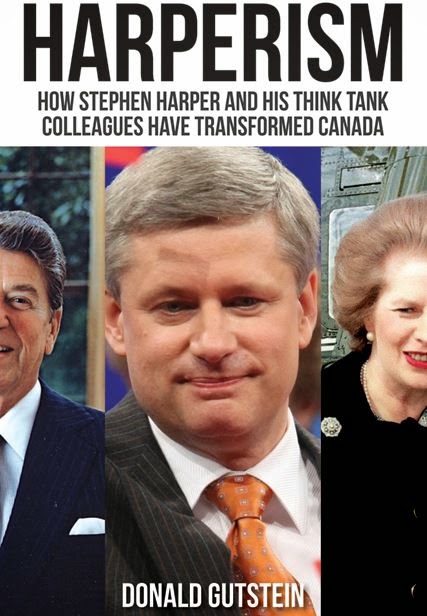
As Donald Gutstein explains in Harperism: How Stephen Harper and his think tank colleagues have transformed Canada, this transformation was achieved through what Hayek called *professional second-hand dealers* - "newspaper columnists and editorial writers who parrot reports by neoliberal think tanks such as the Fraser Institute, Macdonald-Laurier Institute, Frontier Centre for Public Policy, Montreal Economic Institute, and Atlantic Institute for Market Studies."

As it happens, the heads of all those think tanks he mentions :
  • Michael Walker, founding Senior Fellow of the Fraser Institute; 
  • Brian Lee Crowley, founding President of Atlantic Institute for Market Studies [Atlantica!!!], and Managing Director of the Macdonald-Laurier Institute;
  • Peter Holle, President of the Frontier Centre for Public Policy;
  • Michel Kelly Gagnon, CEO of the Montreal Economic Institute
are themselves all members of the Mont Pelerin Society.

Funding to link think tanks, politicians, and journalists comes from corporations and U.S. donors, but also Canadian billionaires like Peter Munk of Barrick Gold and his Aurea Foundation.
DeSmogBlog
The Aurea Foundation was founded by Peter Munk, the head of Barrick Gold, and is a major funder of a small but influential network of free-market think tanks in Canada, including: The Fraser Institute, the Atlantic Institute for Market Studies, the Frontier Center for Public Policy, the Montreal Economic Institute and the MacDonald Laurier Institute.
Gosh, same bunch again.

National Post columnist/CBC political analyst/Manning Centre for Democracy advisor Andrew Coyne is a director at Aurea Foundation, along with former National Post editor Ken Whyte and, up until he became Stephen Harper's chief of staff, Nigel Wright.  


Hayek devotee, former advisor at the federal Department of Finance in 2007-8, and Coyne's friend, Brian Lee Crowley of the Macdonald-Laurier Institute is also particularly ubiquitous in promedia. Crowley has written regular columns for the Ottawa Citizen and G&M (where he spent two years on the editorial board) expounding on subjects dear to Harper : why all of Canada benefits from the tarsands, why we need more foreign investment, the benefits of two-tier healthcare and tankers off the westcoast, and why inequality is no biggie because poverty is a matter of character.

Finance Minister Jim Flaherty hosted a private fund-raising dinner for Macdonald-Laurier Institute, advising invited corporate executives that he was giving MLI his personal backing and "I hope you will consider doing the same."


"Gutstein makes the case that neoliberalism is far more sinister than simply having a desire for smaller government. A central tenet of his new book is that Harper is undermining democracy by marshalling the power of government to create and enforce markets where they’ve never existed before.
“He’s gradually moving the country from one that’s based on democracy to one that’s based on the market, which means that the decisions are not made by our duly elected representatives through the laws that they pass and the regulations that they enact,” Gutstein says."
Coyne responded : 


You can buy HarperismHow Stephen Harper and his think tank colleagues have transformed Canada directly from Lorimer Publishing

Book launch with expert panel on issues raised by the book and hosted by the author - Wednesday October 8, 5:30 to 7:30pm at SFU Harbour Centre 

OK, if you must have a sneak peak, here's a few pages on former Liberal leadership hopeful Martha Hall Findlay at the Calgary School of Public Policy advising Harper how he could successfully dump supply management without losing any votes in order to ease Canada's entry into the investor rights deal, the Trans-Pacific Partnership or TPP. 
The "second-hand dealers" went absolutely apeshit for that one.
.
Edited @ 11:15 for clarity

Monday update : Well this will help to cloister the second hand dealers....

The Tyee : Postmedia could soon own almost every English newspaper in Canada. What could possibly go wrong?

Tyee also has an excerpt from Gutstein's book up today : Meet the people who made possible Stephen Harper's reign.

which in turn leads to this from Andrew Mitrovica :  The Hill media war chorus clears its throat … politely
.

Blog Archive